I practice talking sometimes.

It's a little funny that way: I've worked over the air before, but I have such little confidence in my voice. I stutter. My lips or teeth or jaw have always felt awkward, and I'd even seen a speech therapist when I was young. The braces didn't help, and the full implications of "JAW SURGERY" hit me all at once about a month before it was supposed to happen. I'm also first-generation Canadian, and my parents have never been great with English. I don't know if that's why I took to music and drawing and literature and Math so eagerly.

I've always had a thing for expression, for communication. Anyone who knows me will also know I have a crush on Math for that very reason--among others.

I love that, in Math, any aspect of life or any thought can be modeled using these strange symbols and even stranger rules, both of which can be taught to anyone; ideas can be communicated, proven, or disproven, and even improved upon by any number of people also seeking to find the most perfect expressions.

It's a whole community devoted to perfect universal truths.

... Hehe!

Showing posts with label diagram. Show all posts

Wednesday, February 13, 2008

Involute!

Involute of a Circle

I picked up my Calculus textbook again today, because I was having fun with polar curves and parametric equations.

Man, parametric equations still make me scratch my head sometimes! I get it, it just takes a while to really get what's going on.

Anywho. I came across this problem:

Problem:

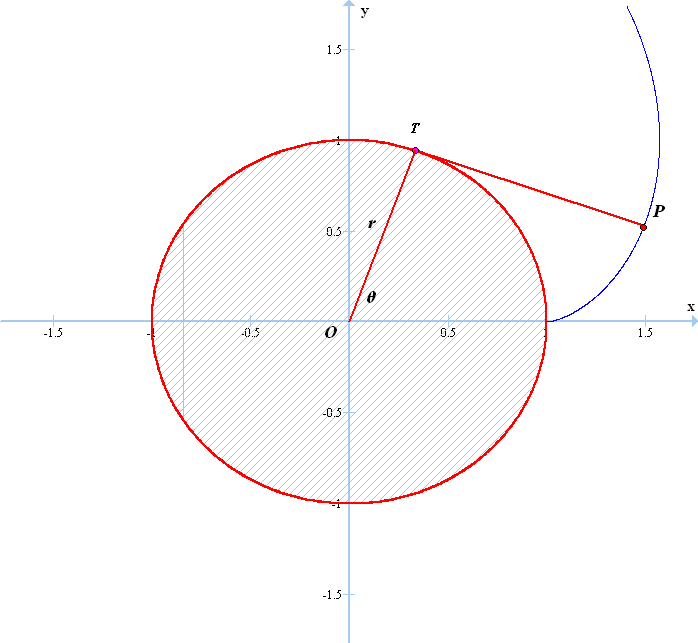
A string is wound around a circle and then unwound while being held taut. The curve traced by the point P at the end of the string is called the involute of the circle.

If the circle has a radius r and centre O and the initial position of P is (r, 0), and if the parameter θ is chosen as in the figure, show that the parametric equations of the involute are
...

I'm purposely leaving this out, because I can figure it out on my own, thank ye very much!

The problem also came with the diagram to the left (I made this in Graph but had to define r, so here, r=1).


Solution

The first thing I did was find the path of the point T.
x = r * cosθ
y = r * sinθ

To get the parametric equations for the path of P, something must be added or subtracted to the path of T.

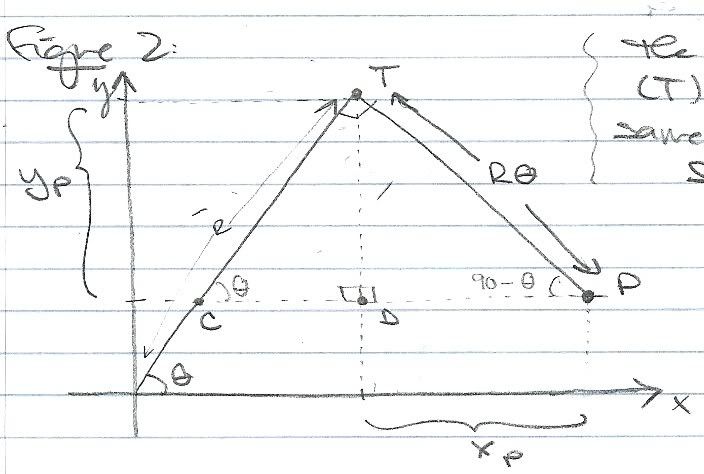
Re-draw the figure as triangles:


The distance from T to P is the same as the arc length for an angle θ. So, that distance is
S = rθ = distance from T to P

I made some reference points:
C := the point on the radius, with same y-value as in point P
D := the point with the x-value of point T and the y-value from point P.
xp := distance along x-axis, from D to P. Add this to the path of T to get path of P.
yp := distance along y-axis, from T to C. Subtract this to the path of T to get path of P.


From these new references, start defining the parametric equations for path of P:
x = r * cosθ + xp
y = r * sinθ - yp.

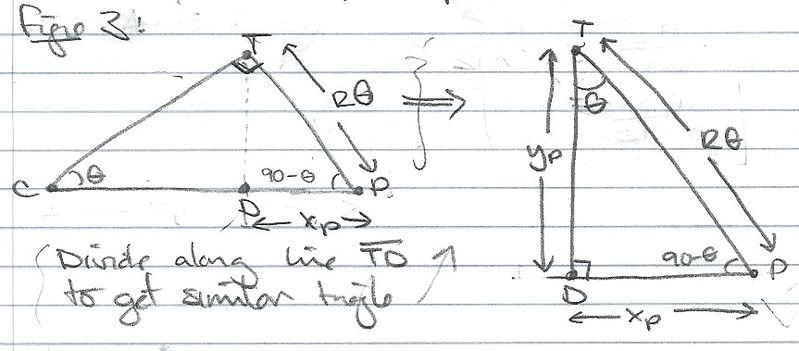
Next determine the values of xp and yp using the right-hand triangle from above:

From here, we can divide the triangle along line TD to get a similar triangle:

From here, we get:
sinθ = xp / rθ
xp = rθ * sinθ

cosθ = yp / r
yp = rθ * cosθ.

Plug these back to get:
x = r * cosθ + r * θ * sinθ
x = r (cosθ + θ sinθ)

y = r * sinθ - r * θ * cosθ
y = r (sinθ - θ cos θ).

Thus, the parametric equations for the involute of this circle are:
x = r (cosθ + θ sinθ)
y = r (sinθ - θ cos θ).

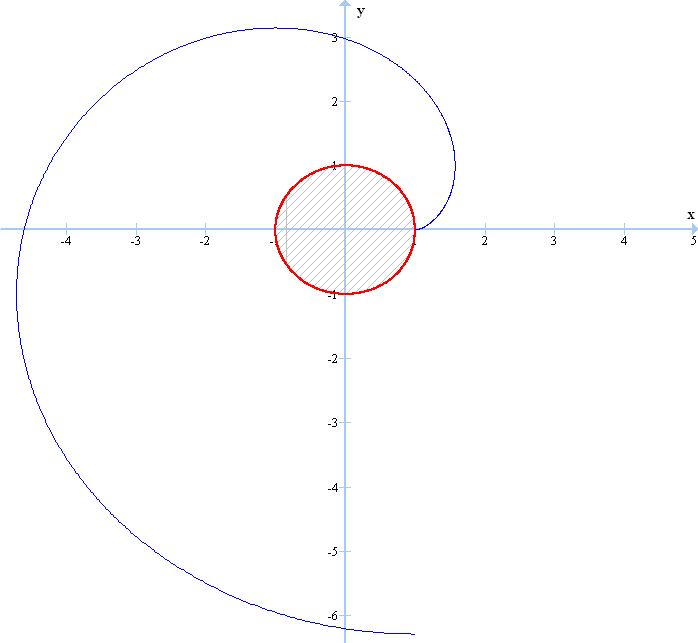
When you graph it from 0 ≤ θ ≤ 2πr, it looks something like the blue curve (but here, r=1):


Woots!
--Charissa

Tuesday, February 12, 2008

Lots of Stuff and Polar Curves

The L Word

So I've started watching The L Word again. At the Rainbow Pride group in University, we started watching Season One The L Word once a week. I've just finished Season Two and have begun Season Three.

I love that this series exists, but I'm a little annoyed that they're mostly lipstick lesbians. Sigh. Same with Exes and Ohs.


Illness

Backstory

Last year, James house-sat in the city for a week. Unfortunately for him, it was the week before exams, when everything was due; and he also caught a nasty bug. And, of course, this is the first time he'd, effectively, lived alone. No Mum, no siblings, not many nearby friends.

On his last day there, I came over to take care of him. I brought him garlic soup, which was a hasty and sloppy experiment involving green roasted garlic, sage, bay leaves and, did I mention garlic? It turned out decently, thankfully. I stayed overnight in the spare room.

Having a robust immune system, I didn't catch his bug that night.

Unfortunately, I later sprayed some artwork with a fixative, and inhaled some acetone. Acetone hurts my throat so bad. I slept fitfully that night, and my nose bled (from the acetone) into my throat (because I was asleep), and I awoke with one nostril entirely plugged and one bone dry, and a throat that felt as though it had been scraped with steel wool.

In comparison with what came next, this was nothing.

The fever started in the late evening, as I recall. It was warm, then cool; then hot, then freezing cold. And everything hurt. Anywhere that my skin was touched, it hurt. I went to wash my hands, and the water falling on my hands hurt. I tried sleeping, but my back was wrought with pain--and my joints! Man, I would really hate to be arthritic, if that was anything like it. All my joints hurt: when I moved and when I was still.

I think the lowest point was after I had fallen asleep a few hours.

I awoke, crying. And I thought, "WTF, why am I crying? Oh! I'm crying because I'm cold! OMG WHY AM I SO FUCKING COLD?!" and I ran upstairs, crying and shivering and sweating, to my mom.

From there, it got better. I was able to sleep, and the pain even went away, slowly but surely. From start to finish, this was about three nights.

Now

Yesterday, I slept badly, and I think, once more, my nose bled backwards into my throat, because I awoke, today, with that same type of scraped-throat pain.

I'm not sure what happened, but I was sitting with my mom, talking about what groceries to get, and then she went off topic and talked about a bunch of other stuff. I'm not sure why, but I got really upset--even punched the wall--the metal part of the wall. And then I ran crying to my room.

Then I went to get groceries. Man, not good. I came back with a splitting headache, partly because I read the bus schedule wrong and went out half an hour early.

I'm not too bad now. Just trying to relax.


St Valentine's Day

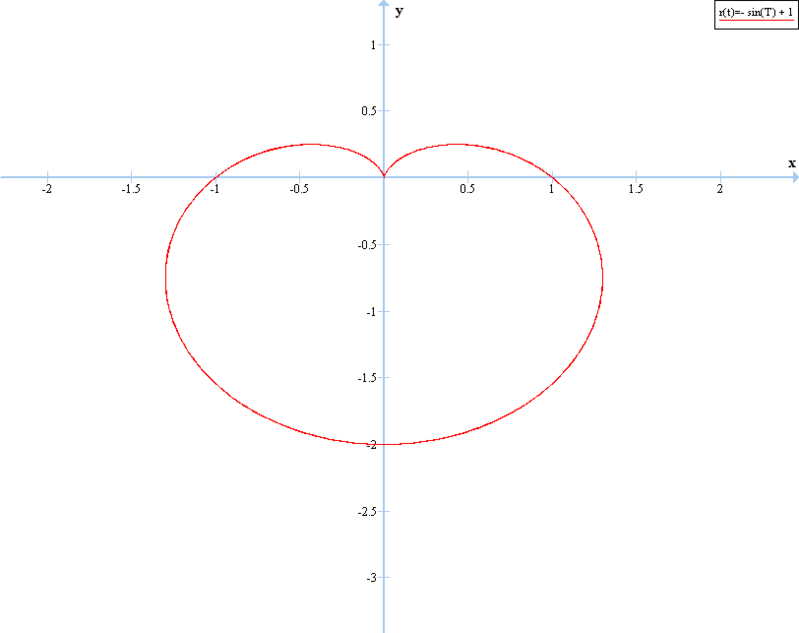
A graph of a cardioid.  A polar curve: 'r = 1 - sin(T)'. St Valentine's Day is rapidly approaching.

There's this guy at work, he seems to be buddying-it-up with me, a bit. It's kinda cute. He's totally not my type--which reminds me! Mark asked me, "On a scale of 1 to 7, how sexy am I?" I said, if seven is the sexiest, he's a five. Then I asked the same question to him. He said, with my long hair, a five; but with my short hair, a three. He's totally not my target audience anyway :P.

I want to send Kevin flowers.

Not specifically Kevin, but I just feel like it would make someone's day, to receive a single, brightly-coloured flower--a gerber, maybe. Something about sending flowers just strikes me as...a beautiful thing to do, and that, the only possible way it could not make someone's day is if the person were allergic or didn't like the colour, or the person had nowhere to keep it.

Anyway.


Polar Curves

This is what I really wanted to talk about!

I recently got this program, Graph, which, as you might've guessed, is a graphing program! It's lovely! I'd donate if I had money!

To the right is a snapshot from Graph, of a cardioid, which is named thus because it looks something like a heart.

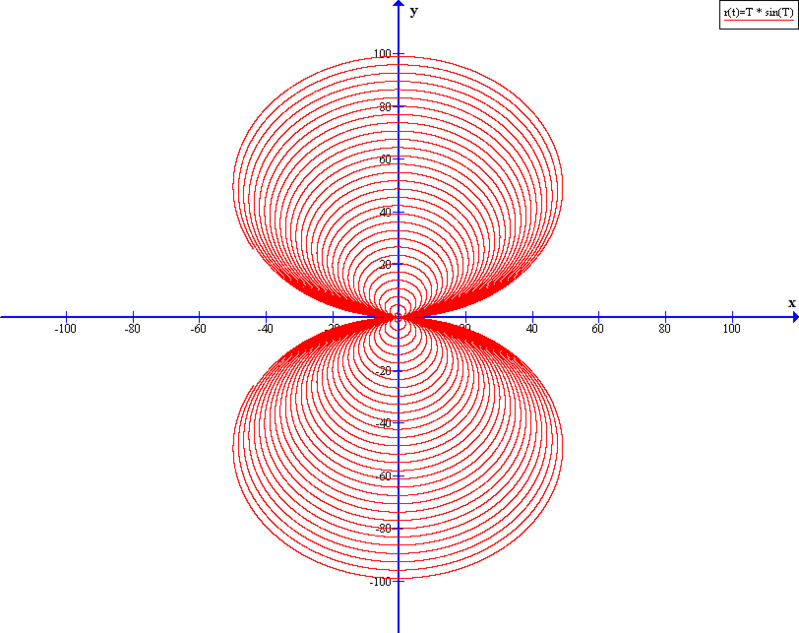
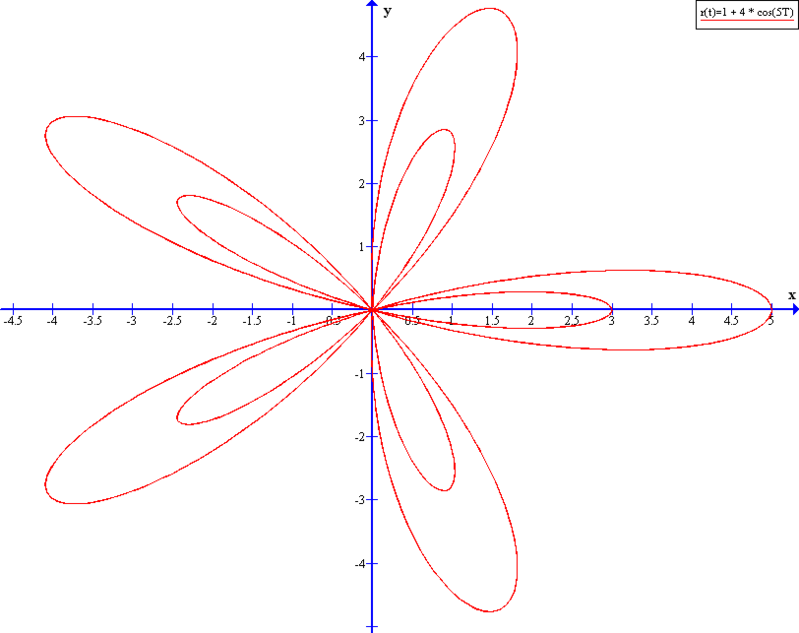
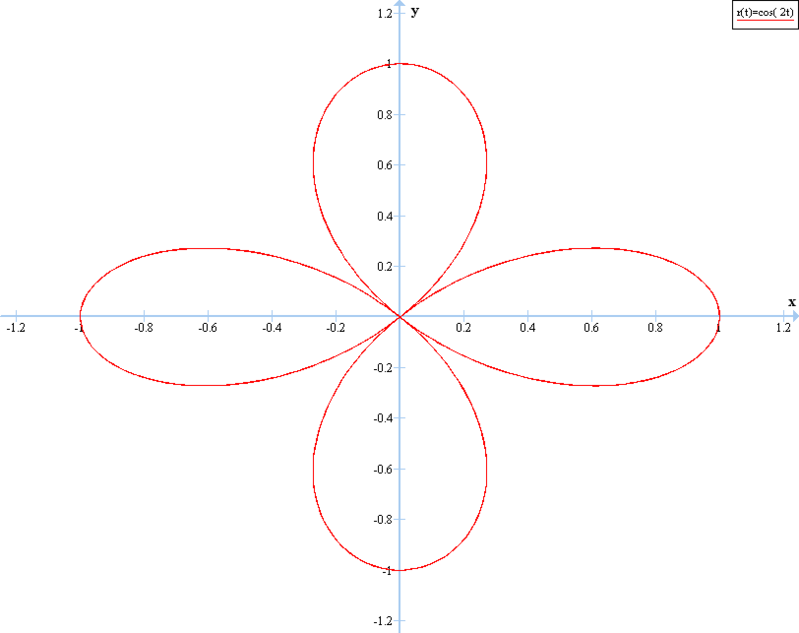
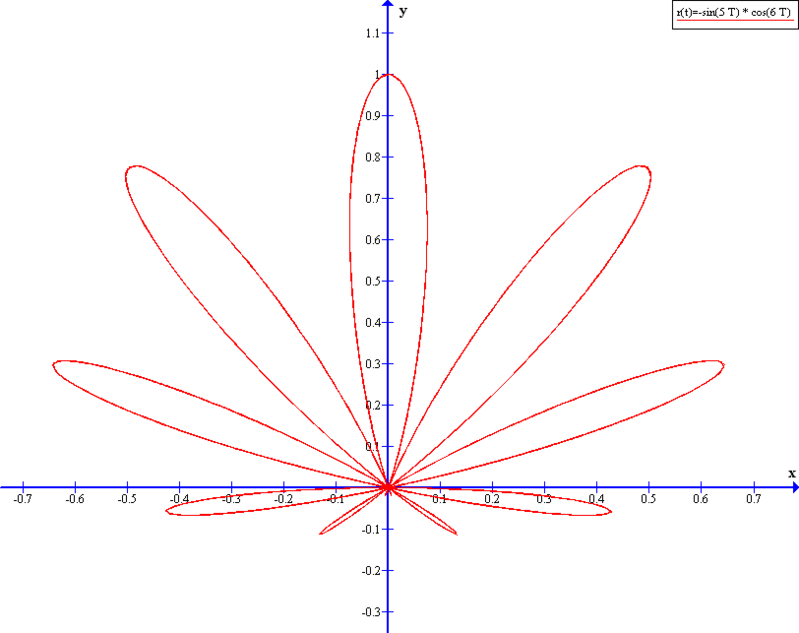
I graphed a bunch of other polar curves on this. Mostly, I made "flowers":


A polar curve, with seven 'petals' or 'leaflets'.  r=-sin(5T) * cos(6T) I also made this one, which looks something like a seven-leafleted plant. Sweet.

So, yeah. Polar Co-ordinates. Great stuff.


Off to sleep, hopefully.
--Charissa

Wednesday, January 30, 2008

Concavities and Venn Diagrams

Concavities!

I'm subbing in for the Calc teacher at Maths School on 02-Feb and 09-Feb. He wants me to cover Concavity. As soon as I finish with a proof of concavity, I'll post it up here.

For now, you get this Venn Diagram as I ponder over Necessary and Sufficient. ...Again. Augh!

Venn Diagram showing relations of odd numbers, prime numbers and even numbers.

I'm not sure who else got taught this way, but I was taught that the rectangle (in this example) is "The Universe", so label accordingly! Put a title on The Universe! Label things that aren't in the circles!


Mm, tired.

--Charissa

Saturday, January 12, 2008

Mistaken Sex, Diagrams, and Everyone is Quitting

I got mistaken for a man today!

Well, maybe, sorta, I dunno. I went to get doughnuts and wanted to use the washroom, but you needed to get a key, and the cashier handed me the mens' room key. Woots.

Also, when I went for lunch with James, I had to use the washroom because I'd walked too fast and had started sweating. Two elderly ladies came into the washroom, separately, and had extremely puzzled expressions on their faces! I had taken off my inner shirt so I could dry it using the blow-dryer, and the first lady eyed me so strangely. I smiled back. I dunno, what else could I do? I suppose I could have declared, "I'm a lady!" but maybe that would've been too odd.


Teaching

We started the Transformations unit today. Some kids aren't quite sure what this whole "negative f of x" or "f of negative x" or "inverse f" is, so they're not sure what the whole "even, odd or neither" thing is, too. THERE'S EVEN A HANDY-DANDY CHART!

Chart - three transformations of f(x).
One of my favourite ways of explaining things is through the use of charts and diagrams, as you may have noticed. Maybe. I love how it's very graphical and intuitive--or maybe it's just intuitive to me. Flow charts are one of my favourites, though.

I decided I'd make another flow chart:

Flow Chart - How to tell if function is even, odd or neither.

Mostly, I made this because one student has already e-mailed me asking how to do the assignment. Sigh. Sometimes I wonder what they do in class!

As a side-note... I noticed the kids tend to get very restless around 16:00. I should keep this in mind.


Army

Augh. We started off with four untrained Privates. In a few weeks, there will only be two. Few weeks after that, maybe only me.
C-- had a series of personal tragedies, and, next to me, I'd say she was the least "army" of us four. So she left.

K-- is the most "army" of us all. She tried doing Reg Force BMQ several times, but, each time, a few weeks before completion, she'd get sick or injured. She just advanced in her Civi job, though, so she won't have any more time for Army from now on.

And, F-- is thinking he might switch over to Reg Force. He'll decide by Tuesday, but he seemed pretty gung-ho about it already.

AUGH! Why?! WHY?? If I had balls, I'd say this was like a kick in the balls. The person in charge of us is pretty intimidating (although, one of the new Officer Cadets said, "Oh, you're cute!" to her face and stayed un-punched). I would not like to be left alone with her.

Sigh. Well, at least I can do BMQ, and sooner, now that I've talked to my employer at the Maths school. Wooo...


Okay, sleepy time.
--Charissa (or is it Charles?)

Sunday, November 25, 2007

Conics and my state of mind

Every two months or so, I go kinda crazy--just a little, though. For about five days, I am restless, pouty, petty, dramatic, anxious, confused--all sorts of nasty things. An additional side-effect is that I can believe anything. I won't know waking reality from dreams; I won't know waking reality from things I read; I won't know waking reality from what I want to believe. Added to this, I have a mild fever that's been off and on for about a week.

For anyone who has an idea the state my mind's normally in, you may have an extra appreciation of the mess this stirs up.


Teaching

We've just "finished" teaching Conic Sections to the kids. I'm not sure what he taught, I was marking their papers so they'd know how they're doing before the exam comes.

In S4 Pre-Calculus, we made a flow chart for identifying types of conic sections. I want the students to have it, but I'm not sure what the teacher has in mind.

That being said...


Because Saturday, December 01 is my fitness test with the Army, I might miss part of Math school that day. That's a review class, and I'd be sorry to miss it. One student is even writing the exam that day because he won't be there next week.

Upcoming Saturdays:
December 01
09:00 - Army fitness test at base. Eep.
14:00 - Review class before exam. One student writing exam early.
December 08
14:00 - Exam on Trig and Conic Sections.
December 15
14:00 - Teacher is away and has not given me any specifics on what to do that day, so I have full control of what we do that day! I want to actually enrich* the students' understanding of Mathematics--because we're supposed to be an "enrichment program".
17:30 - Math School Christmas Dinner. Woots.


* Here is what I want to talk about on December 15...

Conic Sections

History

Way, way back, circa 200 BC, there was a Greek named Apollonius, and he wrote a book called On Conics. This earned him the title, "The Great Geometer". The study of conics has been around for a long time! (Will add more later.)

What are they?

Imagine two hollow cones placed together at their points, sort-of like an hour-glass. By cutting different 2D sections of this, you get "Conic Sections".

Taking a slice of a cone, parallel to an edge gives a parabola.
Taking a slice of a cone at an angle such that you slice through both halves, gives a hyperbola.
Taking a horizontal slice gives either a circle or a single point (if you cut at the joining point).
Tilting that circular slice gives an ellipse.

Definitions

A circle is the set of all points** equidistant from a single point. To draw one, wrap a loop of string around a pin and a pencil and draw as far from the pin as possible without tilting the pencil.


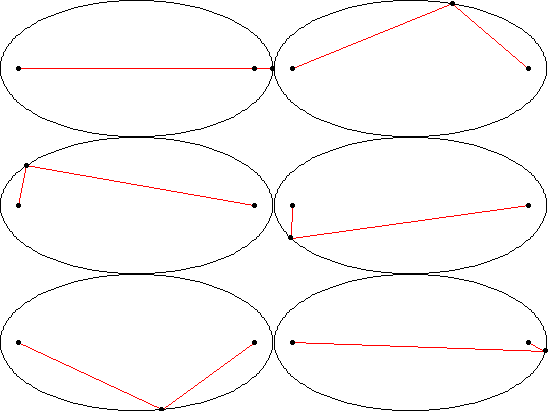
An ellipse is the set of all points** whose distance from both foci is constant (ie: the distance from one point to the first focus plus the distance from the same point to the other focus always adds up to the same number). To draw one, wrap a loop of string around two pins and a pencil and draw as far from the pins as possible.

A parabola is defined as the set of all points** equidistant from a line and a point F (the focus) not on the line (see the right-hand side of this image).

A hyperbola is the set of all points whose distance from one focus, minus the distance to the other focus, is constant.

**(in a plane).


Gravity

The path of a projectile thrown (ie: with another, smaller force in a perpendicular direction) near the surface of the Earth is a parabola.

The path the Earth travels around the Sun is an ellipse.

The path of an object (such as a rocket or comet) on an escape trajectory from a fixed mass (such as the Sun) is a hyperbola.


Reflection

The parabola, ellipse and hyperbola each have "focus points" or "foci". If you've ever seen a satellite dish, you have an idea what this means.

For parabolas, an incoming ray that is parallel to the axis of symmetry is reflected toward the focus.

For ellipses, any ray originating at one focus will reflect toward the other focus (this is still true for the special case of the circle, where the "other" focus is the same focus).

Hyperbolas are a bit more complicated. A ray originating from one focus will be reflected and look as though it originated from the other focus (see this image). (There are a few other cases that work out nicely, that I just can't remember right now.)


Light Cone
...Actually, maybe they won't be ready for this yet. But I'll mention it--briefly.


...I should take that book out of the library again...
--Charissa


Further reading:
http://fti.neep.wisc.edu/~jfs/neep602.lecture8.trajectories.97/neep602.lecture8.trajectories.97.html
"Spacecraft Trajectories"
http://mathworld.wolfram.com/Parabola.html
Mathworld: Parabola
http://mathworld.wolfram.com/Ellipse.html
Mathworld: Ellipse
http://mathworld.wolfram.com/Hyperbola.html
Mathworld: Hyperbola
http://www.practicalphysics.org/go/Experiment_386.html;jsessionid=alZLdQlAHb1
"Drawing" a parabola; teaching aid