I suddenly remembered this problem. It's one of those "think outside the box" dealies. I like the solution, it's elegant and this is a puzzle that can be solved without any outrageous tricks.
Math Problem: Burning Candles
Placed in an enclosed room with only two candles--one which burns for exactly 30 minutes and one that burns for exactly 45 minutes--and a method of lighting the candles, how can one tell when one hour has passed?
Note: The burn times of the candles is not necessarily related to their lengths, so breaking a candle in half, for example, would not ensure that the burn time is halved.
Note: There are not clocks or any other hidden or secret objects in the room--this problem can be solved by only thinking and lighting candles.
Hint: Candles may be lit upside-down, etc with no change in burn time.
Solution
Since there is a candle that will burn for 45 minutes, we can try to make the 30 minute candle burn for 15 minutes instead. Breaking the 30-minute candle isn't helpful, however, lighting it from both sides simultaneously will result in a halved burn time.
Light the 30-minute candle from both sides simultaneously. When it is burnt out, light the 45-minute candle. When that one goes out, one hour will have passed.
Sunday, November 2, 2008
Candle Problem

Sunday, May 11, 2008
Penny Problem!
Math
I subbed in for the Calc teacher again. One student showed me a neat puzzle involving pennies! Seriously, try this out using actual pennies/etc.
I totally recommend finding four pennies and trying this out before looking at the solution.
If you can't see the animation above, here's an explanation:
Objective:If you found that easy, try the next step--use five pennies:Move the pennies into a straight line, any direction. Rules:To start, four pennies are arranged so that each penny touches two others; a parallelogram.
- Move only one penny at a time;
- Pennies may only be moved to a spot where it will touch at least two other pennies;
- Pennies may not be picked up (you may only slide them around);
- Use as many moves as possible, then try to minimize the number of moves.
Seeing the Solution
I think the difficulty comes in seeing the line we're trying to build. We're so accustomed to perpendicular lines that we can't see the 60-degree lines until we've physically moved the pennies around for a few minutes to get used to it.
The Solution
Really, the trick to creating a line in the least amount of moves is to make a gap large enough for a single penny. The last move will be to fill in the gap--no other move can be the last move.
At least four pennies must be present for this; but because of the initial arrangement (a "diamond" shape), this is not necessarily intuitive. To build the gap, you must first build a column of three. Then, you must be able to see the line.
With five set up in one column of three and one column of two, the process becomes more obvious--simply remove the middle penny in the column of three.
From there on, it's the same game: make a gap, and stagger the pennies to build the rest of the line. It's interesting to note, though, that the minimum number of moves is equal to the number of pennies! I found that pretty exciting!
I'll figure out a proof for it, some day... I've still got another proof to figure out; it's for a card trick, and I get the feeling it uses Perms and Combs, which sucks for me.
--Charlie!
PS: Happy Mothers' Day!
Wednesday, February 13, 2008
Involute!

I picked up my Calculus textbook again today, because I was having fun with polar curves and parametric equations.
Man, parametric equations still make me scratch my head sometimes! I get it, it just takes a while to really get what's going on.
Anywho. I came across this problem:
Problem:
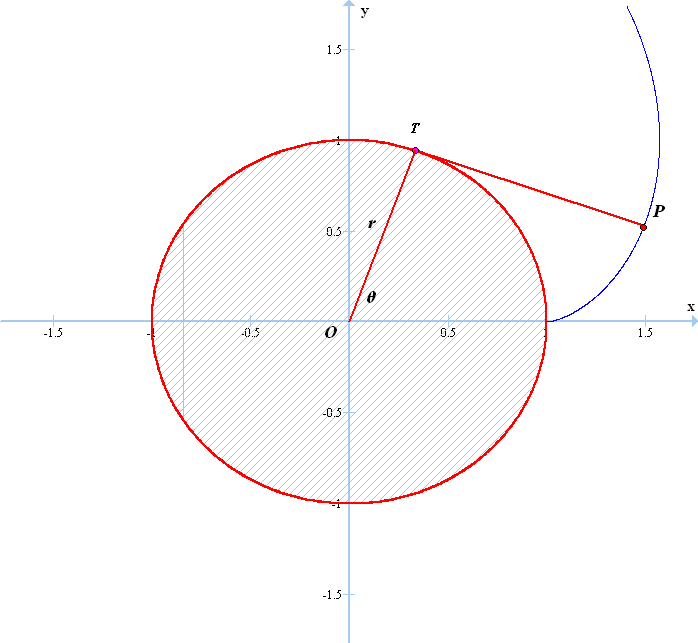
A string is wound around a circle and then unwound while being held taut. The curve traced by the point P at the end of the string is called the involute of the circle.
If the circle has a radius r and centre O and the initial position of P is (r, 0), and if the parameter θ is chosen as in the figure, show that the parametric equations of the involute are
...
 I'm purposely leaving this out, because I can figure it out on my own, thank ye very much!
The problem also came with the diagram to the left (I made this in Graph but had to define r, so here, r=1).
Solution
The first thing I did was find the path of the point T.
To get the parametric equations for the path of P, something must be added or subtracted to the path of T.
Re-draw the figure as triangles:
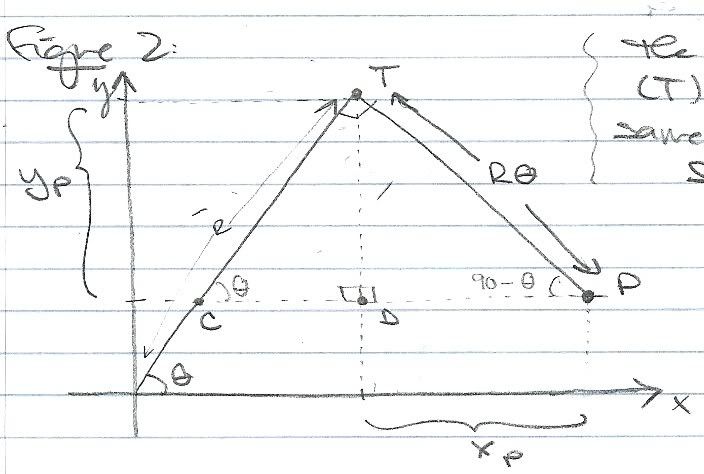
The distance from T to P is the same as the arc length for an angle θ. So, that distance is
I made some reference points:
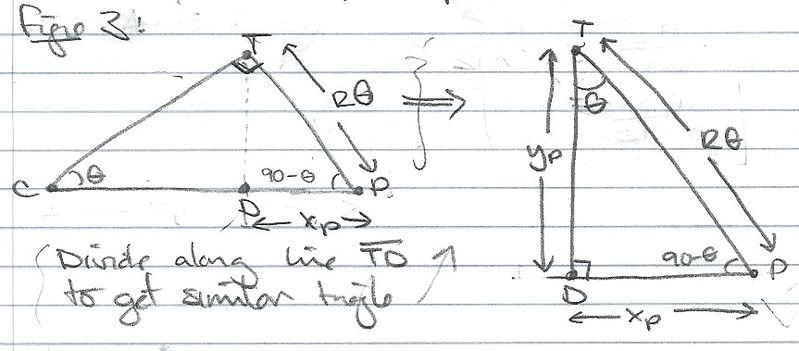
From these new references, start defining the parametric equations for path of P:
Next determine the values of xp and yp using the right-hand triangle from above:

From here, we can divide the triangle along line TD to get a similar triangle:
From here, we get:
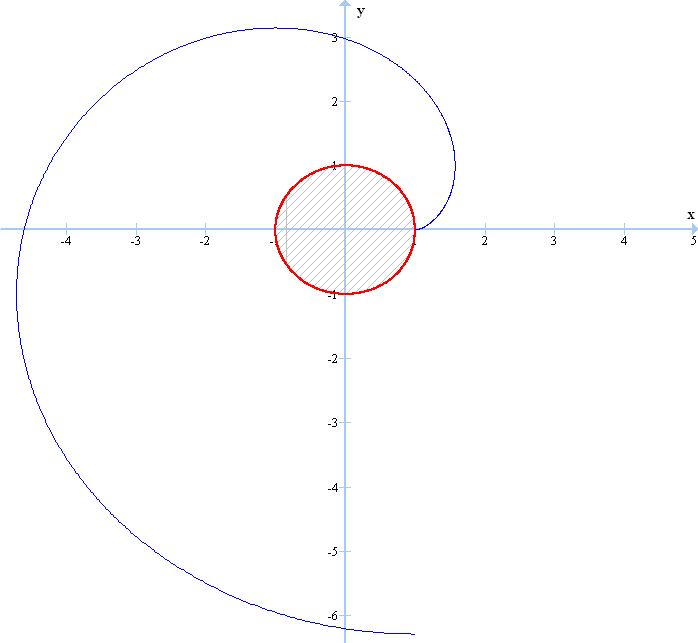 Thus, the parametric equations for the involute of this circle are:
Woots!
--Charissa
Saturday, December 15, 2007
Last day of school
Today was the last day of school before "Winter Break", and I got to lead the class. It was great!
Something I learned: Saying "Yo!" or "Word!" or "I'm-a get ma shizzle ON!" etc is a very easy way to get the attention of grade ten students. Indeed! One student, in particular, was embarrassed for me :). But it works. It's so outrageous, that they immediately cease all other activity and turn their heads.
We went over the kids' exam first (as planned here). Half the class got less than 50%. The average was 53%. We got through the first two pages before recess. I wanted to finish quickly so we'd have time for their "presents" afterward, so I just picked one of the hyperbolas to graph. They actually stayed the first minutes of recess to see it through.
Recess.
After, I handed back their tests. Not happy. I copied down a summary of How to Complete the Square; after, I gave them the flow-chart.
Handed out the "presents": condensed notes on sketching conics; and "Why Conic Sections are Cool!". Talked about "formula sheets", study guides, condensed notes.
I passed around my first "formula sheet" I ever made. It has taped edges to prevent tearing; sprayed with hairspray to prevent graphite smudging (write in graphite so that you can erase and position everything better); everything is labeled; colour and indents help titles to pop out... Only two things about this are dumb: One, I used pencil crayons, which the hairspray dissolved. Two, I spent too much time making it. On the next formula sheets, I smarted up. No colour, no tape; but the indents keep everything orderly.
I told them about speaking "Ukrainian Math Wizard", and (let's call him) Vasil, my prof for Honours Calculus.
Then, I gave them the One Million Beans problem (but with fixed values), saying that if anyone could solve and prove it, I'd bring doughnuts next class (solution below). The top students (grade-wise) couldn't get it, but two girls who were interested but determined they could not figure it out ended up solving it! Well, not necessarily proving it, but close enough. So I owe them doughnuts next class (January 12).
While they were working on it, I told them an Engineers vs. Mathematician joke; they're on the train, one ticket... They laughed--they got it! Just before class ended, I told them the joke about Mathematicians reducing everything to problems they've already solved whereas Engineers can solve "new" problems with originality. If they don't get it now, I'm sure they'll get it later!
Proof of "One Million Beans" Problem
We know that after the beans have been moved back and forth, each jar still contains P number of beans. Now let's look at the number of red and green beans in each jar:
Jar A has
Set up equality:
| P = P | Number of beans in Jar B = number of beans in Jar A. |
| (P - m) + n = (P - n) + m | Cancel (P) on both sides. |
| - m + n = - n + m | |
| 2n = 2m | Cancel (2) on each side. |
| n = m |
| | n - m | = 0 |
for all Natural m, n, P, Q < P.
Okay, I have to get up early tomorrow, then work an 8-hour shift. Sigh. Shouldn't have committed to it...
But I'll mention quickly:
I've been blessed with amazing Math teachers over the years, which probably explains a lot about me. Hopefully, this will allow me to pass along that experience to others.
One student remarked how great it was to have a teacher who didn't mumble (which is especially funny because my father teaches the level below and some kids had him last year). Another said I was exciting and that she was having fun. A few others generally remarked that I explained well and was interesting.
And these are the three (recent) things that have made me feel so worthwhile, in chronological order:
- 1. Finding out my army-boss has harassment issues (it's not everyone--and we're not necessarily bad untrained privates!).
2. My army-boss telling me I look good (dress/deportment).
3. Hearing that the kids enjoyed my teaching.
--Charissa
